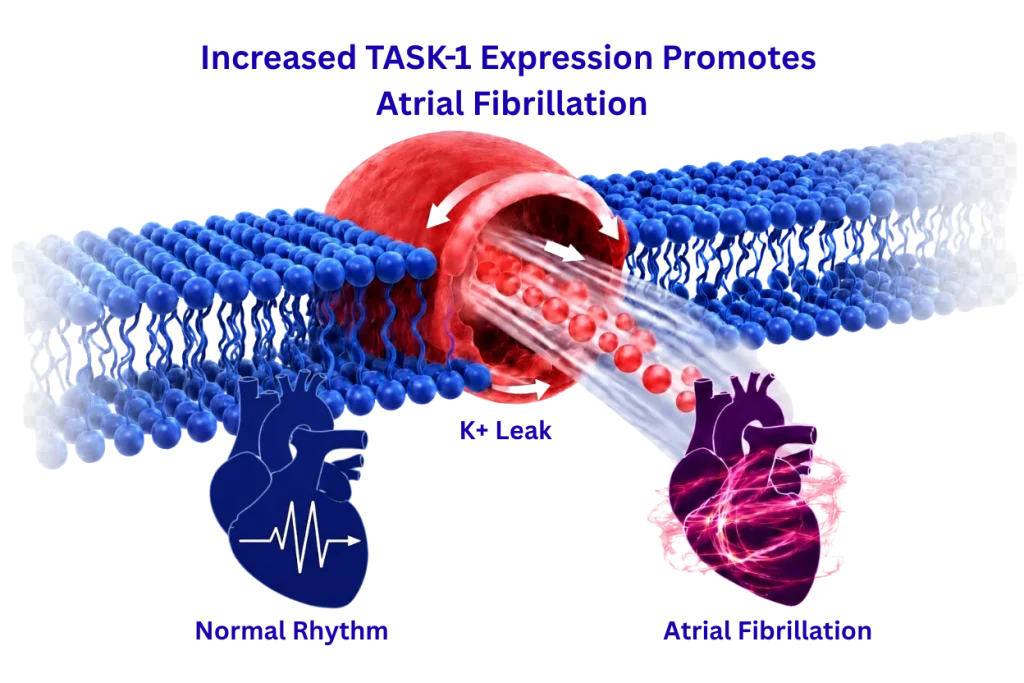
Atrial fibrillation (AF) is fundamentally a disorder of disrupted electrical recovery, or repolarization. In a healthy heart, electrical signals from the sinoatrial (SA) node are followed by a controlled recovery phase—the refractory period—that ensures proper timing between beats.
In AF, this recovery period becomes shortened and unstable. Multiple abnormal electrical sites emerge in the atria, firing prematurely and independently. This leads to self-sustaining re-entry circuits, creating continuous, chaotic electrical activity. The result is ineffective atrial contraction and a heightened risk of stroke, heart failure, and mortality.
This electrical instability is driven primarily by TASK-1 potassium channels (K2P3.1), which act as continuously active “leak” channels. They allow a constant outward flow of potassium ions, helping set the baseline electrical state of atrial cells.
In AF, TASK-1 is significantly upregulated, increasing this electrical leak and shortening the atrial action potential. This enables cells to reset and fire more rapidly, reinforcing the re-entry circuits that sustain the arrhythmia.
TASK-1 offers a highly differentiated therapeutic target due to its atrial specificity. It is minimally expressed in the ventricles but elevated in diseased atria, allowing for targeted modulation without the ventricular side effects seen with many current therapies.
Because TASK-1 is continuously active, even modest inhibition can prolong the atrial action potential and disrupt the circuits driving AF—offering a precise approach to restoring normal rhythm and rate at its source.